
IDX Revises Stock ARB Rules Again: What Does It Mean for Your Investment Strategy?
The Indonesia Stock Exchange (IDX) has once again revised its Auto Rejection Below (ARB) rules for stocks, with the new provisions taking effect from October 20 through December 31, 2026.
The Indonesia Stock Exchange (IDX) has once again revised its Auto Rejection Below (ARB) rules for stocks, with the new provisions taking effect from October 20 through December 31, 2026.
The latest adjustment follows an evaluation of the asymmetric 7% ARB policy, which was introduced just one day earlier, on October 19, 2026.
Under IDX Board of Directors Decree No. Kep-00158/BEI/10-2026, the adjustment aims to support orderly, fair, and efficient trading while improving the price discovery mechanism in the stock market.
For stock investors, the change is important for understanding trading mechanisms. For those who are not actively trading stocks, it also presents an opportunity to learn about the importance of risk management and investment planning.
What Has Changed Under the Latest ARB Rules?
Auto Rejection Below (ARB) is an exchange mechanism that limits sell order prices from falling below a specified threshold during trading.
Under the latest IDX provisions, the following ARB limits apply to stocks listed on the Main Board, Development Board, and New Economy Board:
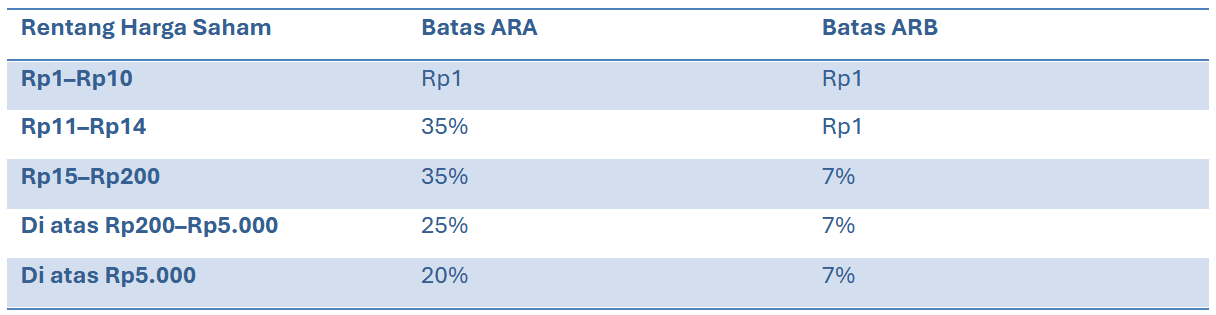
The latest adjustment specifically changes the ARB threshold for stocks priced between IDR11 and IDR14 to IDR1, while the 7% ARB limit remains applicable to stocks priced at IDR15 and above.
The Auto Rejection Above (ARA) limits remain unchanged. Meanwhile, stocks listed on the Acceleration Board and those under the Special Monitoring Board continue to follow the respective auto rejection rules applicable to each board.
The policy will remain in effect until December 31, 2026, and will be reviewed again based on market developments.
The Stock Market Has Daily Price Limits. What About Your Financial Needs?
ARB adjustments govern the permitted price movements within the stock trading mechanism. However, these rules do not guarantee that stock prices will not decline further on subsequent trading days.
Beyond price fluctuations, investors should also consider liquidity, or how easily an asset can be sold when funds are needed. This consideration is equally relevant to everyday financial planning.
Children's education expenses, mortgage payments, healthcare costs, and holiday plans all have different time horizons. Therefore, funds set aside for short-term needs should generally not be allocated entirely to instruments with high price volatility.
For example, money needed to pay education expenses in the coming months serves a different purpose from investments intended to build wealth over the next ten years. Understanding this distinction is an important part of sound financial planning.
The Wealth Management Perspective: Not All Funds Need to Take the Same Level of Risk
From a wealth management perspective, building wealth is not simply about pursuing the highest potential returns. It also involves determining how different portions of an individual's assets can support distinct financial goals.
Mirae Asset Sekuritas Indonesia emphasizes three key considerations when developing a structured investment portfolio:
Investment objectives and time horizon. Funds needed in the near term generally require a different strategy from investments intended for long-term goals, such as retirement planning or wealth accumulation.
Risk profile and tolerance. Every investor has a different financial capacity and comfort level when dealing with investment fluctuations. The selection of investment instruments should reflect individual financial circumstances.
Liquidity and asset diversification. A sound portfolio does not necessarily mean allocating all funds to a single type of investment. An appropriate combination of instruments can help manage risk while maintaining access to funds.
By understanding these three aspects, investors can make decisions based on their financial needs rather than short-term market movements alone.
Money Market Mutual Funds: An Alternative for Short-Term Investment Needs
For investors who are not yet comfortable with stock market fluctuations, money market mutual funds (Reksa Dana Pasar Uang, or RDPU) may be one instrument to consider.
RDPU invest in domestic money market instruments and debt securities with a maturity or remaining maturity of no more than one year.
In general, RDPU carry a relatively lower level of risk than equity mutual funds. This characteristic makes them a potential alternative for short-term financial goals, subject to individual liquidity needs and risk profiles.
Some short-term financial needs for which RDPU may be considered include:
- Setting aside funds for education expenses due in the near future.
- Saving for a holiday or a planned purchase.
- Managing a portion of funds that have not yet been allocated to other purposes.
- Supporting liquidity management within an investment portfolio.
Nevertheless, RDPU still carry investment risks, including net asset value fluctuations, credit risk, and liquidity risk. Neither investment returns nor principal is guaranteed.
For urgent financial needs, investors should also ensure that some funds remain available for immediate access, as mutual fund redemptions are subject to the product's terms and applicable business days.
For those who want to learn the fundamentals of mutual fund investing, Mirae Asset provides educational resources, including the article *Learn Mutual Funds from the Basics: Knowledge Is Key*.
Start Building a Portfolio Aligned With Your Financial Goals With Mirae Asset
Changes to stock trading regulations serve as a reminder that market volatility is an inherent part of investing. However, not every investor needs to adopt the same strategy or level of risk.
For investors pursuing long-term wealth growth, stocks may be one option, depending on their risk profiles. Meanwhile, investors prioritizing short-term fund management may consider instruments such as RDPU as part of their portfolios.
Through M-FUND by Mirae Asset, investors can explore a range of mutual fund products, including money market, fixed-income, balanced, and equity mutual funds.
Investors can also follow the latest developments and insights through the Mirae Asset Mutual Fund News and Insights page.
Ultimately, investing is not simply about how much risk an investor is willing to take. It is also about understanding which funds need to be preserved for upcoming needs and which can be allocated toward long-term growth.
Explore the available mutual fund options and start planning your investments in line with your financial goals with Mirae Asset.
Source: Indonesia Stock Exchange, Letter No. S-13247/BEI.POP/10-2026, dated October 20, 2026, regarding IDX Board of Directors Decree No. Kep-00158/BEI/10-2026.
Disclaimer: This article is intended for informational and educational purposes only and does not constitute a recommendation to buy or sell any particular securities. All investment instruments carry risks. Past performance does not guarantee future results. Investors are advised to read the prospectus and fund fact sheet and consider their financial goals and risk profiles before investing.
