Indonesia Stock Exchange Lowers Stock Auto Rejection Limit to 7% Through December 2026
The Indonesia Stock Exchange (IDX) has officially lowered the stock Auto Rejection Below (ARB) limit from 15% to 7%. The new policy takes effect from October 19 to December 31, 2026, and will be subject to further evaluation based on market developments.
The Indonesia Stock Exchange (IDX) has officially lowered the stock Auto Rejection Below (ARB) limit from 15% to 7%. The new policy takes effect from October 19 to December 31, 2026, and will be subject to further evaluation based on market developments.
The change is stipulated in IDX Board of Directors Decree No. Kep-00157/BEI/10-2026 concerning Regulation No. II-A on Equity Securities Trading.
Details of the Changes to ARB and ARA Limits
Under the latest policy, IDX has adjusted the ARB limit for stock trading in the Regular and Cash Markets. Meanwhile, the Auto Rejection Above (ARA) limit remains unchanged.
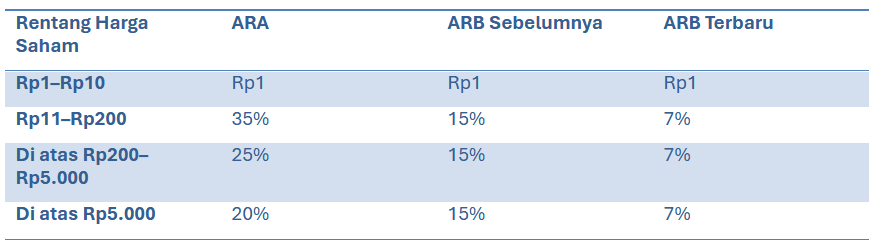
Under the revised rules, the automatic rejection threshold for stock price declines in the price range above IDR 10 is now tighter than under the previous provisions.
What Does the ARB Adjustment Mean for Investors?
Auto Rejection Below (ARB) is a trading mechanism that limits sell order prices from falling below the minimum threshold set by the exchange during a single trading day.
The reduction of the ARB limit from 15% to 7% means that the permitted daily decline in stock prices is more limited under the applicable auto rejection rules. However, investors should understand that the ARB limit does not guarantee that a stock's price will not decline further on subsequent trading days.
In addition, stocks that reach the ARB limit may continue to face selling pressure, particularly when sell orders exceed buy orders.
Mirae Asset's Perspective: Maintaining Discipline in Investment Risk Management
Changes to trading regulations serve as an important reminder for investors to remain attentive to risk management when building their investment portfolios.
From a wealth management perspective, investment decisions should not be based solely on short-term price movements. Investors should also consider their financial goals, risk profiles, and the underlying fundamentals of their assets.
To help manage investment risks, investors can consider the following steps:
- Review portfolios regularly. Ensure that investment allocations remain aligned with financial goals and risk tolerance.
- Pay attention to stock liquidity. The ARB limit does not guarantee that investors will be able to sell their shares immediately when selling pressure intensifies.
- Avoid impulsive decisions. Understand market conditions and the issuer's fundamentals before making investment decisions.
- Maintain diversification. Allocating investments across different asset classes can help manage portfolio concentration risk.
Mirae Asset Sekuritas Indonesia encourages investors to make measured, disciplined investment decisions that remain aligned with their long-term financial goals.
How Long Will the 7% ARB Limit Remain in Effect?
According to the IDX announcement, the revised asymmetric auto rejection policy will be effective from October 19 through December 31, 2026. IDX has also stated that the policy will be reviewed based on market developments.
Investors are encouraged to follow official IDX announcements and monitor capital market developments to adjust their investment strategies accordingly.
For further investment information and educational resources, visit the official Mirae Asset Sekuritas Indonesia website or consult the nearest Mirae Asset branch regarding your investment needs.
Sources: Indonesia Stock Exchange, Letter No. S-13198/BEI.POP/10-2026, dated October 19, 2026, and IDX Board of Directors Decree No. Kep-00157/BEI/10-2026.
Disclaimer: This article is intended for informational and educational purposes only and does not constitute a recommendation to buy or sell any particular securities. All investment decisions involve risks and remain the sole responsibility of each investor.
