
Back
Types of Mutual Funds: Understanding Their Characteristics, Risks, and Investment Horizon
Mutual FundsMutual funds come in several types, each with different characteristics, levels of risk, and potential returns. These differences are primarily determined by their asset composition and investment policies.
Understanding the different types of mutual funds can help investors choose products that are better aligned with their financial goals, investment horizon, and risk profile.
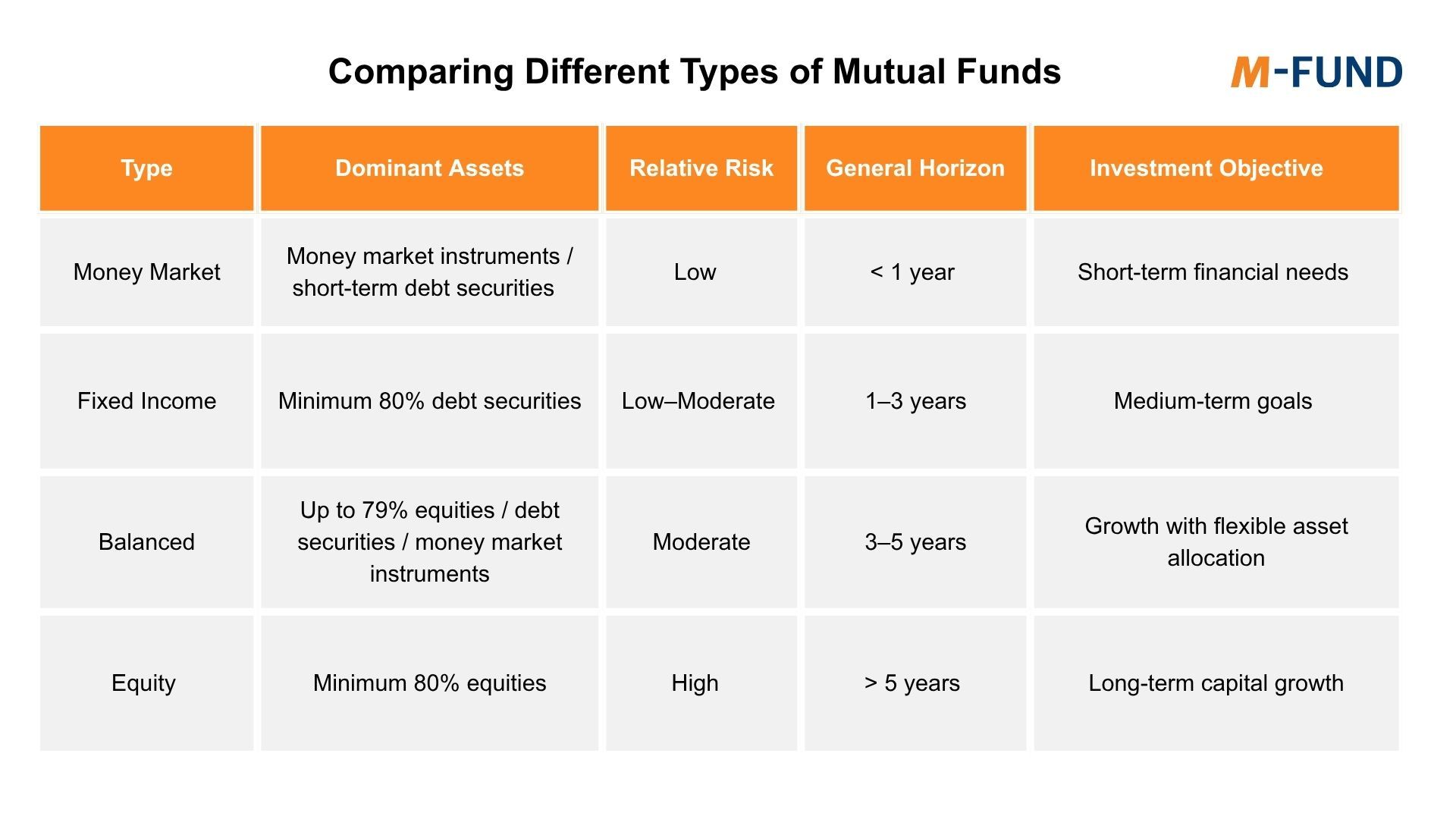
4 Main Types of Mutual Funds
1. Money Market Mutual Funds
Money market mutual funds invest 100% of their assets in money market instruments and/or debt securities with a maturity or remaining maturity of less than one year. Examples include deposits, money market securities, and short-term debt securities.
Their main characteristics are relatively low price fluctuations and generally good liquidity compared with other types of mutual funds. These products are often considered for short-term financial goals, funds that will be needed in the near future, or the conservative portion of an investment portfolio. However, money market mutual funds are not savings accounts or deposits and are not guaranteed by the Indonesia Deposit Insurance Corporation (LPS).
Generally suitable for an investment horizon of less than approximately 1 year.
Key risks include credit risk, liquidity risk, and changes in market conditions.
2. Fixed Income Mutual Funds
Fixed income mutual funds invest at least 80% of their net asset value in debt securities or bonds. Their portfolios may consist of government and corporate bonds.
The term “fixed income” refers to the coupon payments generated by the bonds that make up the majority of the fund’s assets. It does not mean that the value of the investment or the investor’s return is fixed, as returns will still depend on changes in the fund’s Net Asset Value (NAV).
Interest rate movements, changes in issuers’ credit quality, and liquidity conditions may affect bond prices and the fund’s NAV. This type of mutual fund generally sits between money market and equity funds in terms of risk and is often considered for medium-term financial goals.
Generally suitable for an investment horizon of around 1–3 years or longer, depending on the product and investment objective.
Key risks include interest rate risk, credit/default risk, and liquidity risk.
3. Balanced Mutual Funds
Balanced mutual funds may allocate up to 79% of their net asset value to equities, debt securities, and/or money market instruments. Their asset allocation is more flexible than that of the other three main mutual fund categories, which means the level of risk can vary significantly between balanced fund products.
Investors should review the prospectus and fund fact sheet to understand how the investment manager determines asset allocation—whether the portfolio tends to be more aggressive with a higher equity allocation or more defensive with a larger proportion of bonds and money market instruments.
In general, balanced mutual funds are often considered for medium- to long-term goals by investors with a moderate risk profile who seek flexible asset allocation and diversification within a single product.
4. Equity Mutual Funds
Equity mutual funds invest at least 80% of their net asset value in equity securities. Since the majority of their assets are invested in stocks, their value may fluctuate significantly over the short term depending on market conditions, company performance, investor sentiment, and economic factors.
On the other hand, equity mutual funds offer higher capital growth potential over the long term. Investors should be prepared for market corrections and should generally avoid relying on these funds for financial needs in the near future.
Generally considered for an investment horizon of more than 5 years.
Key risks include market volatility, issuer risk, and portfolio concentration risk.
Explore different types of mutual funds and available products on M-FUND by Mirae Asset (click here)
Other Types and Structures of Mutual Funds to Know
1. Sharia Mutual Funds
Sharia mutual funds are managed in accordance with Sharia principles. Their portfolios are invested in Sharia-compliant securities, such as Sharia stocks, sukuk, and Sharia-compliant money market instruments.
They also apply screening mechanisms and the cleansing of income that does not comply with Sharia principles. Sharia mutual funds do not represent a specific level of risk and may take the form of money market, fixed income, balanced, equity, index, or other types of mutual funds.
2. Index Mutual Funds
Index mutual funds aim to track the performance of a particular benchmark index by constructing a portfolio that closely resembles the index.
They are generally managed passively, and their performance is commonly assessed based on how closely the fund tracks its benchmark after accounting for fees and tracking error.
3. Exchange-Traded Funds (ETFs)
An ETF is a mutual fund whose units are traded on a stock exchange. Investors can buy and sell ETF units through the exchange during trading hours.
The transaction price may differ from the indicative Net Asset Value, and investors should consider factors such as liquidity, bid–ask spreads, and transaction costs.
4. Protected Mutual Funds
Protected mutual funds provide a mechanism designed to protect the investment principal at maturity through the structure of their underlying portfolio, provided that investors meet the specified requirements, such as holding the investment until maturity, and that certain risks—such as default of the underlying assets—do not occur.
This protection is not the same as a government guarantee or a guarantee against investment losses. Selling before maturity may result in the protection mechanism no longer applying or may lead to a lower redemption value.
How to Choose the Right Type of Mutual Fund
The selection process should begin with your financial needs rather than simply choosing funds with the highest historical returns. Past performance does not guarantee future results.
Determine your investment goal and the amount you will need, such as for an emergency fund, education, asset purchases, or retirement.
Determine when the funds will be needed. The shorter the investment horizon, the less room there is to tolerate significant fluctuations.
Understand your risk profile—conservative, moderate, or aggressive—including how you may react when the value of your investment declines.
Review the prospectus and fund fact sheet, including the investment policy, benchmark, fees, risks, and management track record.
Verify the legality and regulatory status of the investment manager and product through official OJK channels.
Diversify and review your portfolio periodically rather than allocating all funds to a single product or asset class.
Risks Investors Should Understand
All mutual funds involve risk. The level and sources of risk vary by fund, but common risks include:
Risk of a decline in the value of participation units due to movements in the prices of portfolio assets.
Liquidity risk when portfolio assets are difficult to sell or when large-scale redemptions occur.
Credit or default risk associated with issuers of debt securities.
Risks arising from changes in interest rates, government policies, economic conditions, and foreign exchange rates for USD-denominated mutual funds.
Invest in Mutual Funds through M-FUND by Mirae Asset (click here)
M-FUND by Mirae Asset is a Mutual Fund Selling Agent (APERD) licensed and supervised by the Financial Services Authority of Indonesia (OJK).
Disclaimer: This article is intended for educational purposes only and does not constitute a recommendation or solicitation to purchase any particular mutual fund product. Before investing, prospective investors are advised to conduct their own research before making an investment decision or consult with an Investment Specialist at Mirae Asset.
